This post is part of the Coupang Partners program, and a commission is received accordingly.

The reason you can't exercise is not a lack of willpower

You signed up for a gym but canceled after a month, your YouTube home workout videos are full of bookmarks but nothing but favorites, and your running shoes are just taking up space deep in the shoe closet. Everyone knows that exercise is good for the body. The problem is not starting, but sustaining it.

When many people think of exercise, they first picture an hour at the gym, a 5km run, or being drenched in sweat. Because that image itself feels so heavy, they get exhausted before they even start. However, in reality, the body doesn't need that much. Just 10 minutes of exercise a day can bring about real changes in the body and brain. This article summarizes why 10 minutes is sufficient and how to make building an exercise habit sustainable.

The Reason Our Bodies Have Become Inactive

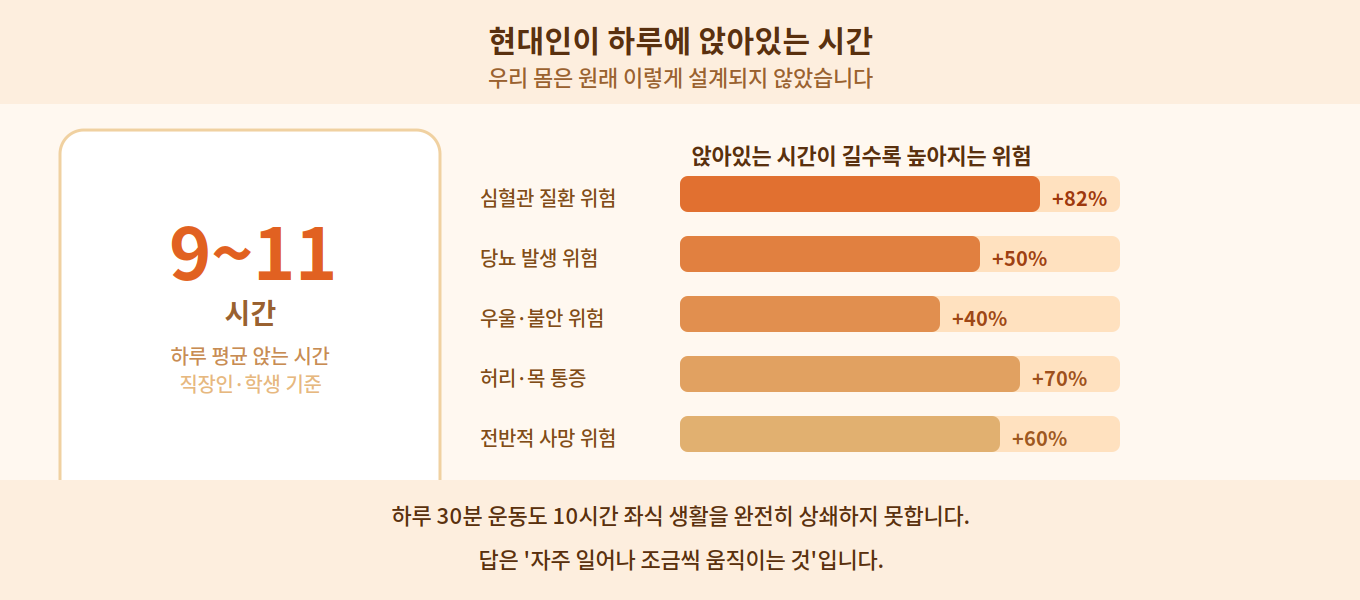
If we look back at a modern person's daily routine, we wake up in the morning, sit down to eat, sit down to commute, sit down to work, sit down to work, and sit down to watch YouTube before falling asleep. According to research, the average daily sedentary time for modern people amounts to 9 to 11 hours. It has been less than 100 years in human history for sedentary lifestyles to become this long.

Humankind has lived for hundreds of thousands of years walking, running, and bending. The body is designed that way. Even more surprising is the fact that even 30 minutes of exercise a day cannot completely offset the remaining 10 hours of sedentary life. This is precisely why moving frequently in small amounts is much more effective for the body than doing it once for a long time.

좌식생활과 신체 영향 이미지

There are four major changes that occur in the body from 10 minutes of exercise a day

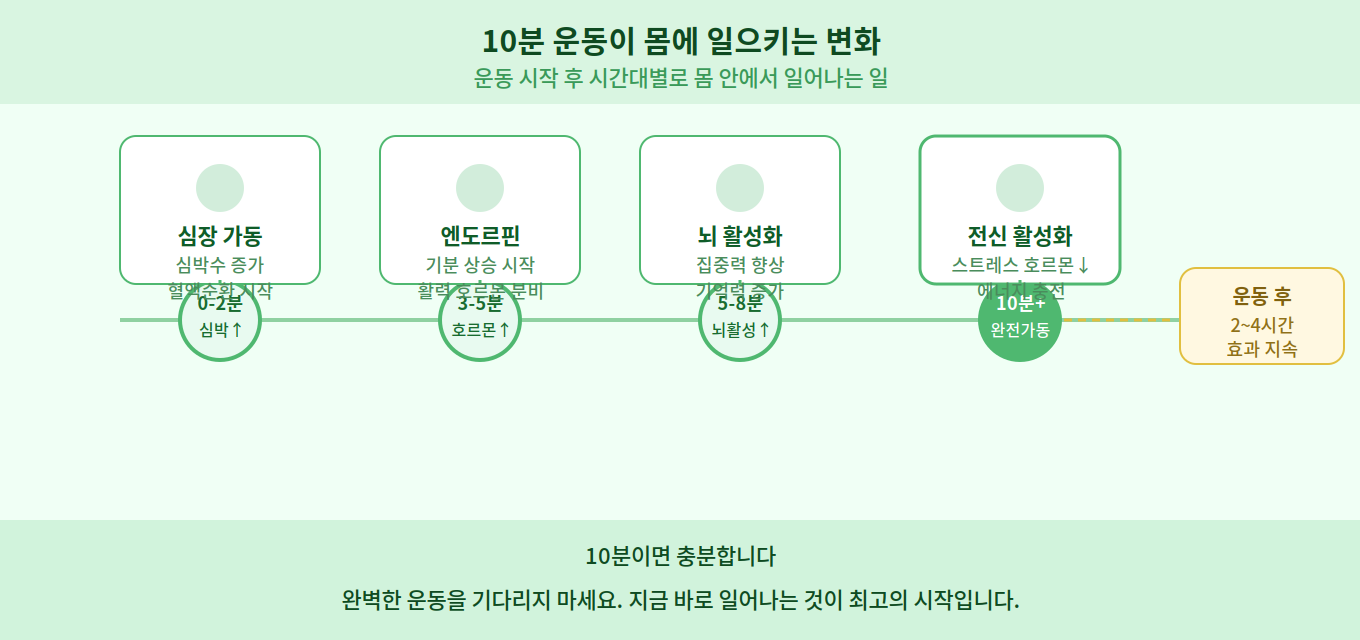
If you doubt whether 10 minutes of exercise a day is really effective, let's look at what changes occur inside the body at different times after you start exercising. You will realize that 10 minutes is by no means a short amount of time.

First change — Activation of blood circulation (within 2 minutes)

Just 2 minutes after you start moving, your heart rate rises and blood circulation becomes active. Oxygen and nutrients begin to be supplied to muscles and joints that have been sitting for a long time. This is the most immediate change you can feel among the effects of walking. The feeling that your body is warming up and stiff areas are loosening is a sign.

Second Change — Mood Improvement (3–5 minutes)

After 3 to 5 minutes, endorphins begin to be released, changing your mood. This is why you feel somehow lighter after taking a walk. Cortisol, a stress hormone, also begins to decrease. Research shows that this effect lasts for 2 to 4 hours even after the exercise is finished.

Third Change — Improved Concentration and Memory (5–8 minutes)

After 5 to 8 minutes, blood flow to the brain increases, boosting concentration and memory. This is precisely why many people have experienced a difference in their concentration during afternoon work after taking a short walk during lunchtime. It is also in the same context why putting down your smartphone and walking for 10 minutes is effective for brain recovery when digital fatigue has accumulated. If you are curious about the relationship between smartphones and digital fatigue, I recommend reading 4 Hours Without a Smartphone, My Brain Started Resting together.

Fourth Change — Full Body Activation (10 Minutes)

After 10 minutes, your entire body becomes activated. Cortisol levels drop, muscles awaken, and the brain becomes sharp. This state lasts for several hours even after the workout ends. This is why 10 minutes of exercise a day can change your condition for the entire day.

10분 운동 시간대별 신체 변화 이미지

4 10-Minute Movements You Can Do Right Now

Exercise doesn't have to be grandiose. Choosing just one of the following four is sufficient. The important thing is not a perfect workout, but the act of getting up and moving itself.

Walking — The easiest exercise recommended for all ages

A walk around the neighborhood; it’s okay to go slowly. The benefits of walking go beyond simple transportation. It helps improve cardiovascular function, joint health, mood, and blood sugar control. The biggest advantage is that you can start right away with just a pair of sneakers. If you are someone who feels very tired on Monday mornings, just a 10-minute walk during lunchtime can make a difference in your condition in the afternoon. If you are curious about the relationship between Monday fatigue recovery and exercise, I recommend referring to Monday Morning, Your Body Knows First.

▶ View sneakers on Coupang

Stretching — Movements especially necessary for people who sit for long periods

Just stretching for 10 minutes, focusing on the neck, shoulders, and lower back, can loosen muscles stiffened by a sedentary lifestyle. You can do it right at home, and no special equipment is required. It is highly recommended, especially for those who spend long hours in front of a computer.

▶ View Yoga Mats on Coupang

▶ View Foam Rollers on Coupang

Use the Stairs — A habit you can practice immediately during your commute

Simply using the stairs instead of the elevator simultaneously strengthens lower body muscles and stimulates cardiovascular fitness. Even climbing just 5 flights a day via the stairs yields significant cumulative effects. You can practice it naturally in your daily life without setting aside separate time.

Free Movement — The most effective method for stress relief

Play two of your favorite songs and move your body to your heart's content. Since there is no formal structure, there is no pressure, and because it is accompanied by enjoyment, it has the highest sustainability. The more stressful the day, the greater the effect.

10분 운동 종류별 방법 이미지

Building an Exercise Habit — Environment, Not Willpower, Is Needed

To sustain 10 minutes of exercise every day, designing the environment is far more important than willpower. This is a fact repeatedly confirmed in habit research. The following four methods provide practical help in building an exercise habit.

Adding Movement to Existing Habits

Turning your neck while drinking morning coffee, taking a lap outside the building after lunch, or rotating your ankles while watching TV. The method of slightly adding movement to actions you are already doing is the most sustainable. In psychology, this is called Habit Stacking.

Setting very small goals

Instead of exercising for an hour a day, let's start with just 10 minutes today. Small successes make the next day happen. The smaller the goal, the easier it is to start, and the easier it is to start, the more likely it is to continue. Attempting to create a perfect routine from the start is actually the most common reason people distance themselves from exercise.

Change your environment first

Let's take out your sneakers next to the bed in advance. What is visible triggers action. Behavioral science research has repeatedly confirmed that environmental setting is far more powerful than willpower. It is the same principle as how changing your sleep environment improves sleep quality. If you want to learn more about the relationship between sleep and recovery, I recommend reading Science Proven That Sleep Is the Best Medicine together.

Don't Blame Yourself for Missed Days

It’s okay to take a day off. Let’s aim to not miss two consecutive days. A consistent routine changes your body more than a perfect one. Giving up just because you missed one day is the biggest failure.

운동 습관 만들기 실천 팁 이미지

Conclusion — Movement Is Not an Obligation, But a Gift to Your Body

There are four major changes that occur in the body from just 10 minutes of exercise a day: improved blood circulation, improved mood, enhanced concentration and memory, and overall body revitalization. These four changes actually happen within a short period of 10 minutes.

If you approach it as something you *have* to do, you won't last long. The feeling of your body coming back to life after sitting for a long time, and the sensation of your mind clearing up from the effects of walking, are the very signals that your body is grateful. Just getting up from your seat right now and rotating your shoulders is enough to start your day.

※ The content of this article is for general health information purposes only. If you have a specific medical condition, please consult a specialist before exercising.