Monday Morning, Your Body Recognizes It First

My eyes open before the alarm even rings. It is still 5:30 in the morning. It is still dark outside the window, and my body feels as heavy as lead under the covers. That feeling of not wanting to lift a finger—it seems my body knows that today is Monday before my brain does.

This sensation becomes more distinct once you enter your 60s. In my 20s, even if I was tired, my body would follow along on its own. In my 30s, even if I pushed myself a little, I would recover in two days. But now it is different. Even though I rested all weekend, why do I start Monday mornings carrying such an unfamiliar weight? In this article, we examine the reasons and practical solutions together.

What is Monday Blues? — It’s Not Just a Mood

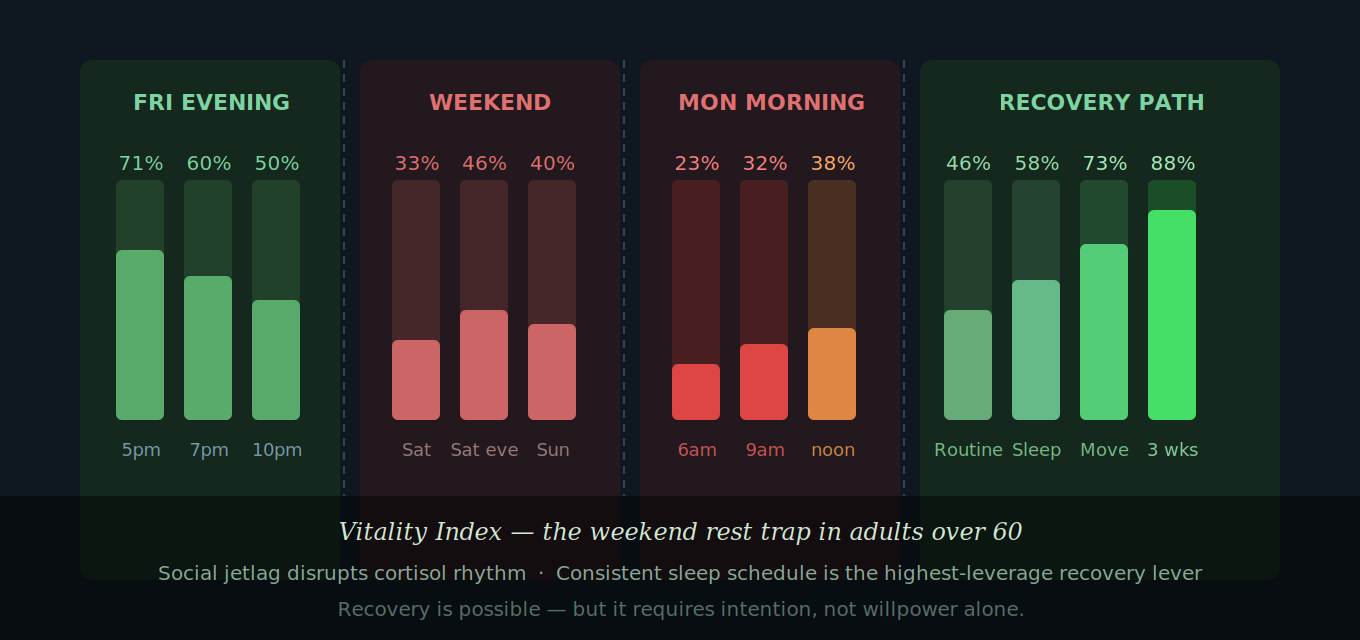
'Monday blues' is often regarded as laziness or a lack of willpower, but in reality, it is a physiological phenomenon deeply connected to the body's biological rhythm. Although it does not have an official name, the field of sleep medicine explains this as the concept of "social jetlag." Social jetlag refers to the phenomenon where changes in lifestyle patterns—going to bed and waking up later than usual during the weekend—disrupt the body's internal clock, much like an international time difference. Even a change in sleep schedule for just a day or two affects our body's circadian rhythm (24-hour biological cycle). Then, on Monday morning, when you should be waking up at your usual time, your body is still stuck in the "weekend time zone." While people in their 20s and 30s can correct this jet lag within a day or two, the recovery speed is entirely different for those in their 60s. This is because the flexibility of the biological rhythm decreases with age. You are not alone. This is not a matter of willpower, but an honest signal from your body.

There are three main reasons why you feel particularly tired on Mondays.

There is a clear reason why fatigue on Monday mornings feels particularly severe compared to other days. It is not simply because you are in a bad mood because the weekend is over, but because three changes are actually occurring simultaneously within your body.

The first reason — A misalignment of the biological clock

Cortisol is a vitality hormone secreted in the morning to wake up the body. When you are young, cortisol levels spike rapidly immediately after waking up, activating the body quickly. However, as you age, the timing of this secretion slows down and the amount decreases. When this is combined with the fact that your biological clock was pushed back by 1 to 2 hours during the weekend, it takes much longer for your body to fully wake up, even though you have opened your eyes. This is exactly the sensation commonly referred to as "the body not cooperating."

Second Reason — Deterioration of Sleep Quality

The key point for those in their 60s is that the structure of sleep changes rather than the total amount of sleep. The proportion of deep sleep (slow-wave sleep) decreases, while light sleep and the frequency of waking up in the middle of the night increase. Even if you lie down for eight hours, if you lack deep sleep, your body does not receive the signal that you have "rested enough." If you went to bed later than usual on the weekend, you will face Monday with your entire sleep cycle disrupted.

Third Reason — Accumulation of Unresolved Fatigue

Stress and mental fatigue accumulated at work are often not completely relieved within just two days of the weekend. This is because brain fatigue lingers longer than physical fatigue. This fatigue accumulates like debt. It carries over to the next week without being resolved, and that debt arrives like a bill every Monday morning. The psychological burden of having to "get through this week" stimulates the sympathetic nervous system, leading to a vicious cycle that lowers sleep quality.

Practical Solutions to Reduce Fatigue

There is no way to completely eliminate Monday blues. However, there are ways to help your body greet Monday mornings much more lightly. The key is not grandiose changes, but the adjustment of small, consistent habits.

Maintaining Consistency in Sleep Schedule

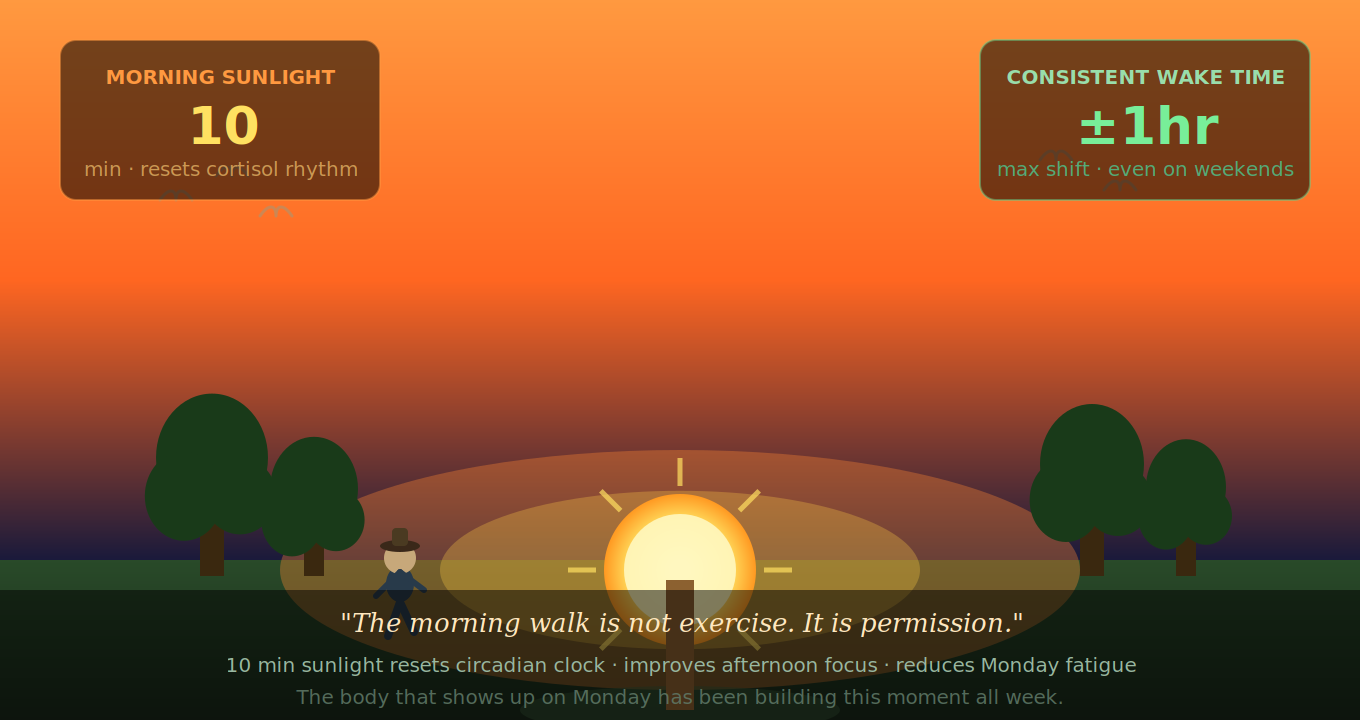
Even on weekends, it is most effective to keep your wake-up time within an hour of your weekdays. Sleeping in is sweet, but it further disrupts your circadian rhythm. The key is to fix your wake-up time before your bedtime. Sleep experts call this a "Sleep Anchor." When your wake-up time is fixed, your entire sleep cycle stabilizes.

Resetting your biological clock with morning sunlight exposure

Getting 10 to 15 minutes of natural light in the morning is the most natural way to reset your circadian rhythm. Sunlight promotes serotonin secretion and helps melatonin be secreted on time at night. Just taking a short walk outside the building during lunchtime can change your concentration in the afternoon and the quality of your sleep in the evening.

Protein-focused breakfast

After the age of 60, muscle mass loss is directly linked to fatigue. A carbohydrate-heavy breakfast causes blood sugar levels to spike sharply and then drop rapidly, increasing fatigue during the morning. A protein-rich breakfast, such as eggs, tofu, fish, and Greek yogurt, helps maintain stable blood sugar and sustains morning energy.

Securing Intentional Recovery Time After Work

It is advisable to intentionally set aside 20 minutes of "doing nothing" after work. This is a time to sit quietly with your eyes closed or do light stretching, without TV or smartphones. This time, during which the brain switches from work mode to rest mode, replenishes your energy for the next day.

아침 햇빛 산책 및 회복 이미지

5 Practical Tips You Can Use Starting This Week

Knowing the solution is meaningless if it is difficult to put into practice. The following are specific tips that can be applied starting this week.

Tip 1. Create a 'Prep Routine' on Sunday Night

Take out the clothes you will wear the next day and prepare the ingredients for breakfast in advance. Even these small actions will noticeably reduce the cognitive load on Monday mornings. The fewer decisions you have to make, the lighter your morning will feel.

Tip 2. Start with Easy Tasks on Monday

Do not cram the most difficult and important tasks into Monday morning. If you start with tasks that can be handled with low concentration, such as checking emails or organizing your weekly schedule, your body will naturally get into a work rhythm.

Tip 3. Reduce Caffeine Intake on Weekends

It is common to drink more coffee than usual on weekends. Caffeine lowers the quality of sleep and disrupts your circadian rhythm. Avoiding caffeine after 2 PM on weekends helps with your condition on Monday morning.

Tip 4. Wake up your body with a light walk on Sunday

Light activity is actually more effective for recovering from fatigue than complete rest. Taking a 20-30 minute walk on Sunday morning or afternoon activates blood circulation and reduces the heaviness in your body on Monday morning.

Tip 5. Don't be harsh on yourself

Feeling heavy on Monday morning is not a sign of weakness. It is proof that your body, which has worked for decades, is still holding its ground. You don't have to start in perfect condition. Just start. It takes time for your body to catch up, but eventually it will.

Conclusion — Monday blues are not something to be eliminated, but something to be managed.

While Monday blues are felt more distinctly as one gets older, they are not a sign of declining physical strength or aging. They are the result of the combined action of three factors: a disrupted circadian rhythm, poor sleep quality, and the accumulation of chronic fatigue. Understanding the causes and adjusting small habits one by one is a realistic approach.

Consistency in sleep schedule, exposure to morning sunlight, a protein-rich diet, and time for recovery after work—consistently practicing just these four things will definitely make a difference in the weight of Monday mornings. Don't try to change everything at once; let's start with just one thing this week.

Start by putting your smartphone in your pocket and walking outside the building for just 10 minutes during your lunch break today.

📌 Recommended reading: If you are curious about the effects of smartphone use on fatigue and sleep → 4 Hours Without a Smartphone, My Brain Started to Rest