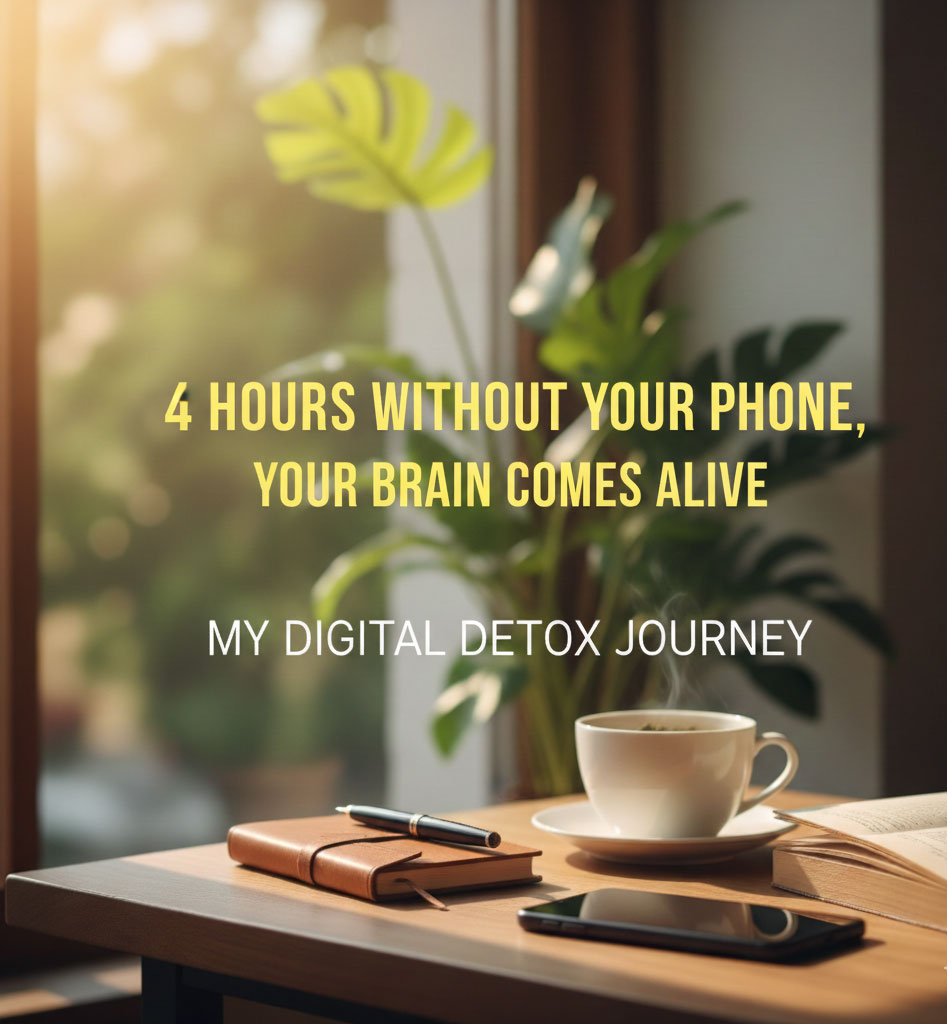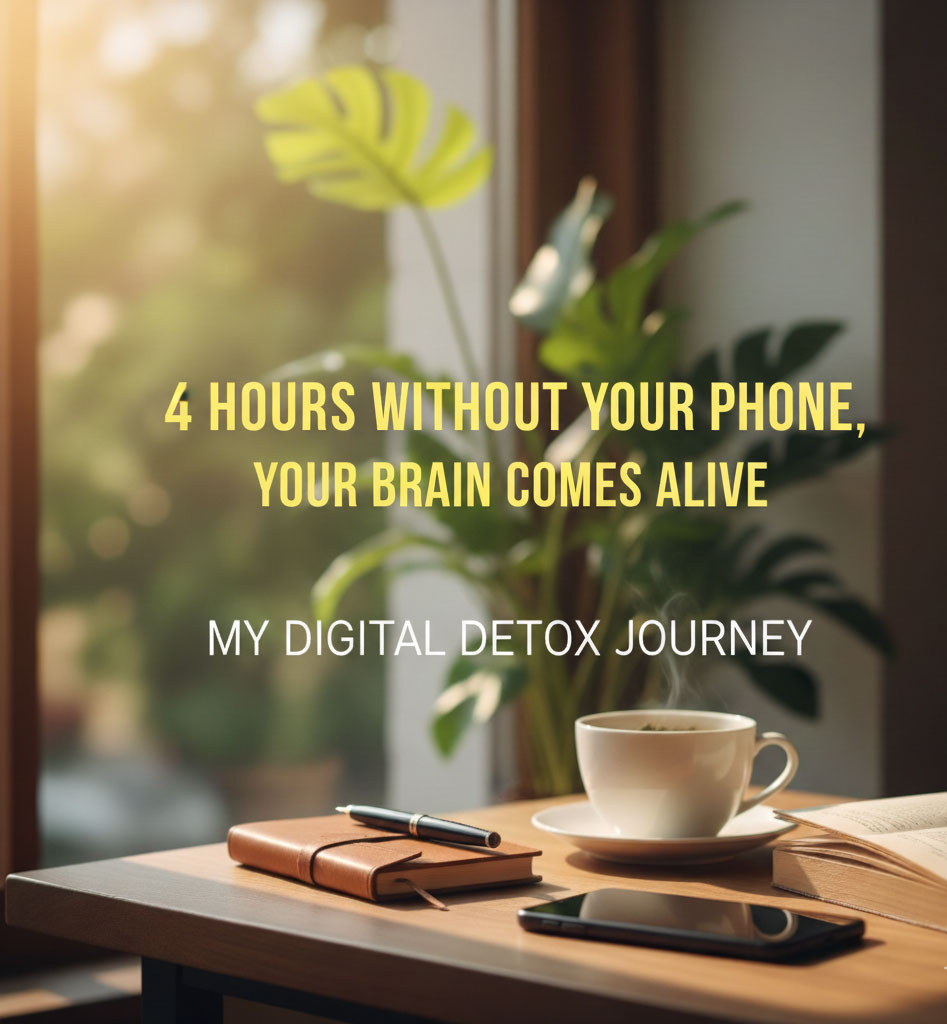
Is Your Brain Currently 'Overloaded'?

A life where you check KakaoTalk as soon as you open your eyes in the morning, scroll through social media even in the bathroom, and let the YouTube algorithm take over your time until you go to sleep. This likely doesn't sound unfamiliar. A modern person's day begins with a smartphone and ends with a smartphone.

The problem is that if this lifestyle accumulates, the brain cannot rest properly. Even if you haven't been diagnosed with smartphone addiction, if your concentration drops, you feel tired for no reason, and thinking deeply about things becomes increasingly difficult, it is a sign that digital fatigue is already building up. In this article, based on my actual experience of reducing my phone usage for four hours, I will summarize how digital detox affects the brain.

What is Digital Detox?

Digital detox refers to the act of intentionally distancing oneself from digital devices such as smartphones, tablets, and social media. The reason the word "Detox" is attached is that digital stimuli accumulate in the brain like toxins, causing fatigue and stress.

It is not simply about keeping devices away, but a process of reclaiming the focus and control lost to the digital environment. The goal is not complete disconnection, but rather creating a habit of using them consciously.

디지털 디톡스 개념 이미지

There are three main reasons why smartphones fatigue the brain.

There is a clear reason why your head feels particularly heavy and digital fatigue is felt severely on days when you use your smartphone for a long time. It is not simply because your eyes are tired, but because the brain itself falls into a state of overload.

**First Reason — Over-stimulation of Dopamine**

Short-form videos, like notifications, and new comments — all of these stimulate the brain's reward circuits, causing dopamine to be released. The problem is that this stimulation is too fast and intense. This is why smartphone addiction is so frightening. The brain constantly seeks stronger stimulation, and without it, it feels boredom and anxiety. The fact that you keep reaching for it even after putting it down for a moment is not a matter of willpower, but a problem with the way the brain reacts.

**Second Reason — Overload of the Frontal Lobe**

While using a smartphone, the brain's frontal lobe works without rest. The process of judging information, reacting, and selecting the next content is repeated ceaselessly. The frontal lobe is a key area responsible for restoring concentration, making decisions, and regulating emotions. If this area is continuously overloaded, symptoms such as decreased concentration, mood swings, and clouded judgment appear. This is the most direct reason why you should reduce your mobile phone usage.

The Third Reason — Rising Cortisol Levels

Notification sounds, rapidly passing news, and unconscious comparisons on social media — these stimuli promote the secretion of cortisol, a stress hormone. If cortisol levels remain consistently high, the quality of sleep deteriorates, leading to chronic fatigue and anxiety. The experience of looking at your smartphone right up until bed and then having trouble falling asleep is precisely the effect of this cortisol.

Why 4 Hours in Specifics — The Minimum Time for the Brain to Begin to Recover

Is 1 or 2 Hours Insufficient? There is a reason for setting digital detox in 4-hour increments.

It takes at least 60 to 90 minutes for the brain to break free from excessive dopamine stimulation and transition into a stable state. The first hour is a time to overcome anxiety and the urge to reach for things. From then on, the brain begins to enter full-scale recovery mode.

By the second or third hour, the frontal lobe gradually stabilizes, thoughts become organized, and the sense of the surrounding environment awakens. And after 4 hours, cortisol levels drop noticeably, and the brain begins to send signals that it has "rested enough." If a 30-minute break is like stretching, 4 hours is equivalent to actual sleep. If it is too short, the lingering effects of stimulation remain, and if it is too long, the practice itself becomes difficult. Four hours is the balance point between effectiveness and feasibility.

디지털 디톡스 4시간 실천 이미지

Trying It Myself — What Actually Happened During 4 Hours

I actually tried turning off my smartphone and spending four hours on it on a Saturday afternoon. The first 30 minutes were more uncomfortable than I expected. I kept fiddling with my empty pockets, worried about what to do if an important call came in. I realized that this is what smartphone addiction is like.

After an hour, things started to change little by little. I could see the leaves swaying outside the cafe window. The aroma of coffee felt clearer than usual. The texture of a paper book touched my hands anew. It felt like my senses were coming back to life.

By the second or third hour, the thoughts I had been putting off began to naturally organize themselves. I gained a new perspective on unresolved worries, and ideas started to come to mind. Without a smartphone, I actually felt like my mind became clearer.

When I turned my smartphone back on four hours later, there was no major news that felt like the world was collapsing. I realized anew just how much we had been clinging to unnecessary connections.

This is how it changed — Changes after 4 hours of digital detox

The following three effects can be obtained by practicing a digital detox for four hours.

The first effect — Restoration of concentration

The first change I noticed after the detox was the restoration of my concentration. Previously, I would constantly get distracted even while reading a single page of a book, but after the detox, I was able to concentrate for 30 to 40 minutes without interruption. This is a natural change that occurs as the prefrontal cortex is freed from a state of overload. If you practice a detox the evening before work or study, your concentration improves noticeably the next day.

**Second Effect — Relief from Digital Fatigue**

The tension in my shoulders and neck eased. My eyes felt at ease. The vague heaviness in my head felt lighter. Digital fatigue is not merely eye strain, but fatigue of the entire brain. I could feel the tension draining from my entire body with just four hours of disconnection. In particular, as my cortisol levels dropped, falling asleep in the evening became much easier.

**Third Effect — Restoration of Time Density**

The four hours that used to fly by like ten minutes while looking at my smartphone felt incredibly dense now that they were filled entirely with my own time. It didn't feel like I had more time, but rather that I was using my time properly. I realized that reducing phone usage is not simply about looking at it less, but about improving one's quality of life.

**5 Tips for a Fail-Proof Digital Detox**

**It is difficult to sustain simply by turning off your smartphone without a plan. You can practice it much more easily by utilizing the following methods.**

**Tip 1. Set a Specific Time**

**Set a clear date and time, such as "This Saturday from 2 PM to 6 PM," rather than thinking "I'll try it someday." Vague plans do not get executed.**

**Tip 2. Prepare Alternative Activities in Advance**

**Plan a book you wanted to read, writing utensils, and a light walking route in advance.** If you don't decide what to do when you don't have your smartphone, you will find yourself reaching for it sooner or later.

Tip 3. Inform those around you in advance

Telling family or acquaintances in advance that you "will be unreachable for a few hours this afternoon" significantly reduces psychological anxiety. Worrying about unexpected contact is one of the main reasons that hinders a detox.

Tip 4. Start short

If 4 hours feels overwhelming from the start, you can begin with 1 to 2 hours. The important thing is not perfect execution, but consistent repetition. As the number of repetitions increases, the brain will come to remember a stable state even without digital stimulation.

Tip 5. Check usage patterns after the detox

Observe which app you opened first after the detox is over. That is the stimulus your brain relies on most strongly. Simply recognizing this provides substantial help in reducing mobile phone usage.

Conclusion — Reclaiming the initiative in technology

Digital detox is not about turning off your smartphone forever. It is about giving a short recovery time to a brain exhausted by three causes: excessive dopamine stimulation, prefrontal overload, and elevated cortisol. Four hours is not just a number; it is the minimum standard for the brain to actually begin recovering.

Restoring concentration, relieving digital fatigue, and restoring time density—having experienced it firsthand, I found these three changes appeared much faster than expected. Let's start this weekend by turning off your smartphone for just four hours. The world works better than you think.

📌 Recommended reading: If you are curious about the causes and solutions for Monday morning fatigue → Monday Morning, Your Body Is the First